
Missaukee County Court Records After a Jail Arrest
After a Missaukee County arrest, the first record usually belongs to the jail: intake, custody, bond eligibility, and release processing at Missaukee County Jail under Sheriff Wilbur "Wil" Yancer and jail administration by Lt. Jesse Harwood. The court record starts when a complaint, information, or other charging paper is filed. The Missaukee County Prosecuting Attorney, David DenHouten, is the local official identified by the county as reviewing, authorizing, and prosecuting felony and misdemeanor violations committed in Missaukee County.
That distinction matters because booking language can be preliminary. Jail inmate records can help with current custody and booking context, while the court case shows what charges were actually filed and how they changed. Booking photos and photo requests are a separate records issue covered under jail mugshots. The court record is the source to use for docket entries, arraignment details, bindover, plea, dismissal, sentencing, and set-aside status when those entries are public.
The county's court materials divide local criminal work between the 84th District Court and the 28th Circuit Court. District Court handles misdemeanors and early felony stages, while Circuit Court handles felony-level matters after bindover. A person booked into the county jail can move through both systems before a case is resolved.
How to Find Missaukee County Court Records After an Arrest
Use the jail first only when the arrest is very recent and custody status is the immediate need. For court records after an arrest, search MiCOURT Case Search or the local Circuit Court public-record search link. The county Circuit Court page says criminal and civil records can be searched at no fee, and copies cost $1 per page with a $5 charge for faxed or emailed documents.
- Search MiCOURT by defendant name or case number, checking the participating court selection for 84th District Court or 28th Circuit Court when available.
- If nothing appears, allow for filing delay, spelling differences, a nonpublic case, or the possibility that the case belongs in the other court.
- For misdemeanors, traffic misdemeanors, and felony preliminary stages, contact 84th District Court at (231) 839-4967 ext. 214.
- For felony cases after bindover, contact or search the 28th Circuit Court at (231) 839-4967 ext. 202.
- For copies, ask the court clerk about page charges, fax or email fees, and whether the requested record is public.
MiCOURT and local court dockets are case-record tools, not full criminal-history products. For a broader Michigan criminal-history check, use the proper Michigan State Police ICHAT process where legally appropriate. MDOC OTIS is different again: it tracks people under state prison, parole, probation, escape, or absconder jurisdiction and should not be treated as a fresh county jail booking record.
Custody can also move outside the court docket. Use Michigan VINE for custody-status notifications, the BOP inmate locator for federal sentenced custody, and ICE ODLS for immigration detention. The statewide Michigan Sheriff Connect app has public Apple and Google Play listings, but no Missaukee-specific roster or court-record feature was verified from those listings.
The MiCOURT Case Search portal is the statewide place to begin when a Missaukee County arrest has moved into a filed court case.
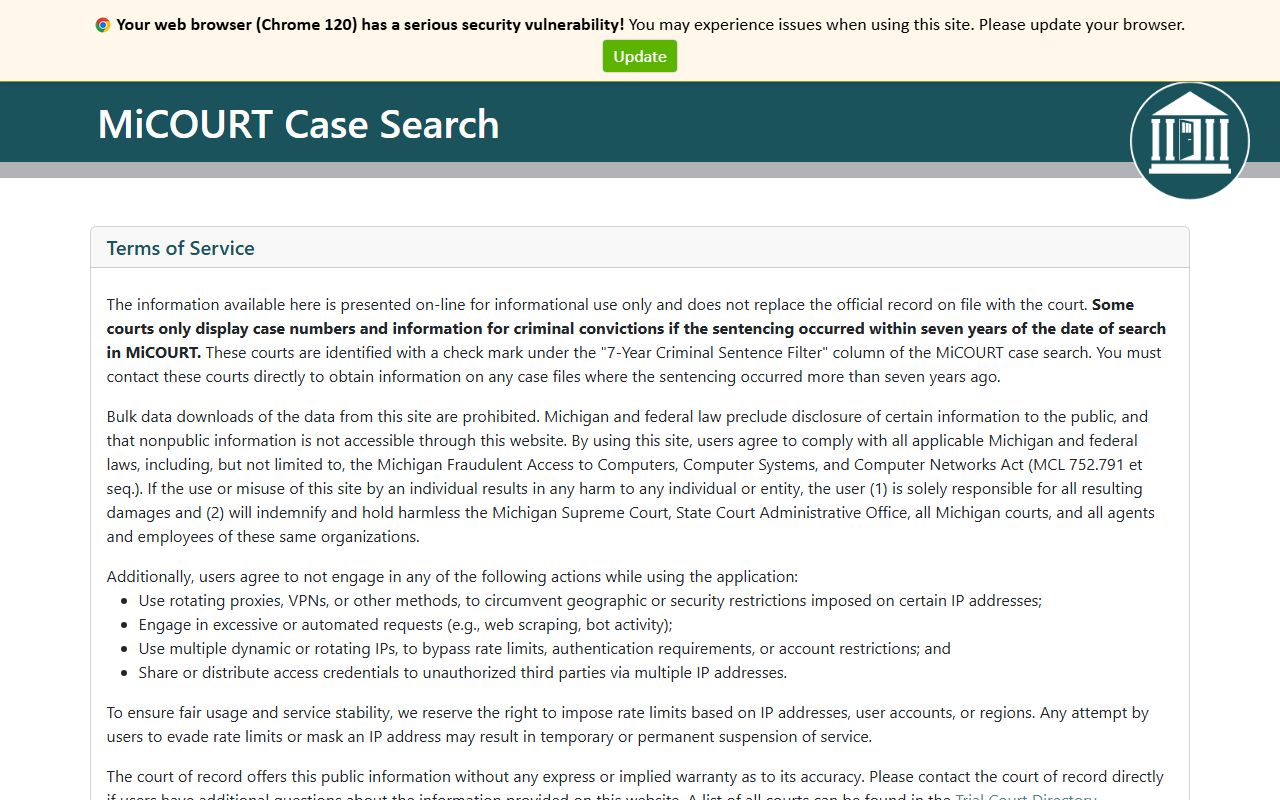
Use the court and case-type filters carefully because a felony can begin in District Court and later appear in Circuit Court after bindover.
How Charges Get Filed After an Arrest: Complaint, Information, and Indictment
Booking at Missaukee County Jail does not by itself create the full court record. The charge record begins when the prosecutor files a charging document or when the case otherwise enters the court docket. A complaint may start many criminal cases. An information is commonly used for felony charges after preliminary examination, bindover, or waiver. An indictment is a grand-jury charging document and is less common in ordinary local cases.
| Document | Filed By | Common Use | What to Check |
|---|---|---|---|
| Complaint | Officer or prosecutor | Starts many misdemeanor cases and early felony proceedings | Charge wording, offense date, bond, and first appearance entries |
| Information | Prosecutor | Felony cases after bindover or waiver | Final felony charge list in Circuit Court |
| Indictment | Grand jury | Less common serious felony charging route | Counts alleged, filing court, and later amendments |
| Warrant | Court | Authorizes arrest or custody action | Whether the warrant is active, recalled, served, or tied to a bond order |
Charge Status in Court Records After a Missaukee County Arrest
Charge status can change as a case moves. A jail booking charge may be different from the prosecutor's filed charge, and the filed charge may later be amended, reduced, dismissed, bound over, or resolved by plea or trial. Always read each count separately instead of assuming that one docket outcome applies to every charge.
| Status | What It Means |
|---|---|
| Pending | The charge is open and has not reached a final disposition. |
| Amended / Reduced | The wording, statute, severity, or count changed from an earlier version. |
| Bound Over | A felony moved from District Court to Circuit Court after preliminary stages. |
| Dismissed | The charge ended without a conviction on that count. |
| Plea / Sentenced | The defendant entered a plea or the court imposed the penalty after conviction. |
| Set Aside / Expunged | An eligible conviction or qualifying arrest record was removed from ordinary public view under Michigan law. |
Bond and Release After an Arrest
Bond is usually addressed at the first appearance or arraignment in District Court, then it can change if the court modifies conditions. Jail staff can receive payment and explain custody logistics, but the court sets the legal amount and release conditions. Missaukee County publishes one local payment detail: a bond and commissary kiosk is located at the Sheriff's Office west entrance off Canal St. Confirm custody, exact bond, holds, accepted payment methods, and any kiosk fee before arriving.
| Bond Type | How It Works |
|---|---|
| Cash Bond | The court requires a cash amount before release. |
| Ten-Percent Bond | The court may allow a 10 percent deposit when that option is ordered. |
| Surety Bond | A bail bond company may post bond if permitted and arranged by the defendant or family. |
| Personal Recognizance | The person is released on a promise to appear and obey court conditions. |
| No-Bond Hold | Release is blocked unless the court changes the order. |
| Other-Agency Hold | Another county, MDOC, federal agency, parole or probation office, or ICE hold can keep the person in custody after local bond is posted. |
Warrants That Lead to an Arrest
No official Missaukee County online active-warrant search or most-wanted list was located in the county materials reviewed. The Sheriff's Office uniformed law-enforcement page identifies warrant arrests as a local function, including locating and taking people into custody on arrest warrants. For an active warrant question, use the Sheriff's Office main line, dispatch for non-emergency routing, records/civil process, and the court tied to the case. For a booking that already happened, call Corrections at (231) 839-4338 ext. 2 and then search the court docket for warrant, bond, failure-to-appear, or hearing entries.
Charges vs. Convictions
An arrest or filed charge is an accusation. A conviction requires a guilty plea, guilty verdict, or other final finding accepted by the court. Court records can show both, so read the disposition line and each count's status before describing a person's case history.
| Charge | Conviction | |
|---|---|---|
| Stage | Accusation filed in court | Final guilty finding, plea, or judgment |
| Burden | Probable cause or charging standard | Beyond a reasonable doubt for trial conviction |
| Record Meaning | Shows what was alleged | Shows what was proven or admitted |
| Possible Result | May be amended, reduced, or dismissed | May lead to sentence, supervision, or later set-aside eligibility |
Sealed vs. Expunged Arrest Records
Michigan uses set-aside and arrest-record-removal procedures rather than one simple rule for every case. MCL 780.621 governs applications to set aside eligible adult convictions. MCL 764.26a addresses qualifying situations where charges are not filed or are dismissed and the arrest record must be removed from ICHAT and handled through the statute's process. Court, jail, and state databases may update on different timelines.
| Sealed or Restricted | Set Aside / Expunged | |
|---|---|---|
| Visibility | Hidden from ordinary public access or limited by court rule, order, or statute | Removed from ordinary public view under the applicable Michigan set-aside process |
| Law Enforcement | Some official access may remain depending on the record type | Some official access may remain under Michigan law |
| Eligibility | Depends on juvenile status, sealed case type, active investigation, or court order | Depends on the offense, disposition, waiting period, and Michigan statute |
Background Check Considerations
Public court lookup is not the same as a compliant background check. A docket can omit nonpublic material, lag behind current court action, or show dismissed and pending counts alongside convictions. Employment, housing, credit, insurance, and similar screening require legally compliant sources and procedures.
Important: Public lookup content is not a consumer report and cannot be used for FCRA-covered screening decisions.
Restricted Court Records After an Arrest in Missaukee County
Not every record connected to a Missaukee County arrest is public. Juvenile matters, sealed or set-aside records, victim information, active investigations, nonpublic law-enforcement material, and court orders can limit access. Michigan FOIA gives a right to inspect, copy, or receive public records of a public body unless an exemption applies, but court records and sheriff records follow different access paths. Use the originating court for docket and copy issues, and use the Sheriff's Office records process for incident, arrest, booking, or photo records when releasable.